
La Paz-Bolivia
La Paz known as the wonder city in the Bolivia map is located bordering with Peru, is a high plateau area reach more than 4100msm. La Paz transformed itself into a cosmopolitan city, blending cultures and modernity.
History of La Paz
La Paz history is the history of ideas, individuals, social movements, and organizations that have sought peace, averted war, and opposed international conflict. All of which involves acquaintance with scientific schools and vehicles of thought, also an extensive awareness of philosophical, moral, religious, cultural, and aesthetic traditions tending toward. La Paz history was born, officially, in 1913, and has been thriving at colleges, thanks to the labor of many activists, scholars and intellectuals. The history of La Paz are, in the foreseeable future, obstacles to further disseminating a message of hope, realism and commitment to the ideals.
The city of El Alto is located in the Murillo province of the department of La Paz, on the Altiplano plateau at 4070 meters above sea level.
It is part of the metropolitan area of the wonder city of the world along with the city of La Paz, making it the highest city in the world and the second most populous and growing city in Bolivia.
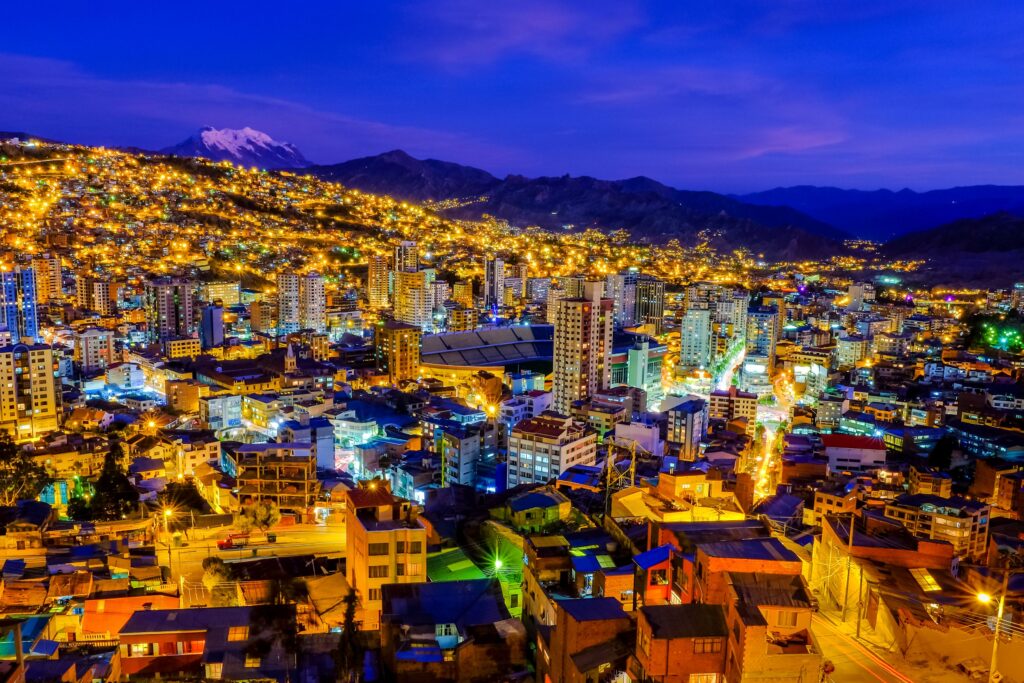
It is characterized for being one of the youngest cities in Bolivia, with more than 3 decades of existence, it is currently projected as a municipality with tourist vocation, in which it promotes innovative tourist circuits and routes with different themes for different national and foreign audiences.
La Paz
Aymara New Year: It coincides with the winter solstice and marks the beginning of a new agricultural cycle. It is celebrated with ancestral rituals that honor Pachamama (Mother Earth) and the sun, giving thanks for life and the fruits of the earth.
Paceño Carnival: As in other places in Bolivia, the carnival in La Paz is experienced with parades, music, water, foam and joy. Groups such as the Chukutas and J’iska Anata stand out, combining tradition and celebration at every step.
Traditions of La Paz
The traditions of La Paz, Bolivia, are a rich blend of indigenous roots and colonial customs, manifesting themselves in vibrant festivities, religious rituals and unique cultural expressions. Among the highlights are the Alasitas and Ekeko celebrations, the Carnival of La Paz, the Feast of the Lord of the Great Power, and the Aymara New Year.
La Paz is a place where ancient traditions coexist with modernity, giving life to a calendar full of colorful celebrations, vibrant dances and rituals full of meaning.
Alasitas: Of Aymara origin, this fair celebrates abundance and desires. People buy miniatures of everything they dream of having houses, cars, money, titles and offer them to Ekeko, the god of prosperity, in the hope that one day they will come true.
Heritage
Pachataka or “Horca del Inca”
Only 600 meters distant from the town of Copacabana, in the department of La Paz and on top of the Kesanani Hill, is located one of the most curious pre-Columbian archeological complex: Pachataka, which means �where the time is measured.
The Spanish conquistadors who encountered it were mistaken in what they called it, the “Horca del Inca” (the Inca’s Gallows), for this is an ancient astronomical observatory. Archaeological research indicates that it was also employed to view the solstices and equinoxes with great accuracy.
This observatory is dated to around 1764 BC, according to astronomers at the Institute of Cosmic Physics. At that time, Chiripa was the major culture in the Lake Titicaca basin.
Lake Titicaca is one of the sites where the remains of the Inca civilization can best be seen in Bolivia. On the Island of the Sun are the Chinkana ruins, the Pilkokaina Inca palace and the Rock of the Puma.
The Chinkana (Labyrinth) is nearly 200 meters away from the Temple of the Sun (Sacred Rock of Origins). The labyrinth is a multilevel underground construction that is filled with many corridors and rooms, some with several doors and branching paths. Since so many roofs over these rooms and passageways have collapsed over time.
Island of the Sun
World Cultural Heritage
Tiwanaku
Concurrently, the archaeological complex of Tiwanaku, the symbolic seat of the Andean civilization prior to the Inca Empire and which is also a significant pilgrimage center since time immemorial, was enlisted as a UNESCO World Heritage Site in 2000.
This distinction was awarded due to the outstanding archaeological and cultural merit of its stone ruins in the city. From here, a group of individuals made pivotal advances with construction technology, farming, animal husbandry, and plant-fiber and animal-fur weaving..
Bolivian Dishes
Originally from La Paz, the capital of Bolivia, the Plato Paceño is a traditional Bolivian dish. Its recipe was created during a three-month siege. At first, the dish did not include meat, but later, animal protein was added over time.
Food
Traditional Food of La Paz, Bolivia
La Paz, Bolivia has a rich and varied cuisine, with typical dishes that show both Andean traditions and the influence of other cultures. Some of the most popular dishes include:
Chairo: a thick soup made with meat, dried potatoes (chuño), and vegetables.
Plato paceño: a plate with corn (choclo), potatoes, broad beans, and cheese.
Fricasé: a spicy pork stew made with chili (ají).
Sándwich de chola: a sandwich with pork leg (pernil), pickled vegetables (escabeche), and crispy pork skin (cuerito)..