
Bolivia Salt Flats
Discover why the Salar de Uyuni, Bolivia Salt Flat is a natural treasure. Its cultural and ecological significance makes it a unique destination.
Why Bolivia Salt Flat is the most important in the world
A salar, also called a salina or salitre, is a large expanse of flat land covered mainly by salt and minerals. It is formed when water from a lagoon or basin slowly evaporates in dry or semi-arid areas, leaving behind a shiny layer of salt. Basically, it is a place where more water evaporates than enters, causing minerals to accumulate on the surface.
It is used in the manufacture of glass, soap, plastic, paper, paints, synthetic rubber, cosmetics, medicines and electric batteries; chlorine soda, water treatment, petrochemicals. In addition to the richness provided by its dominant components, the salt flats present themselves as extensive landscapes of great attraction.
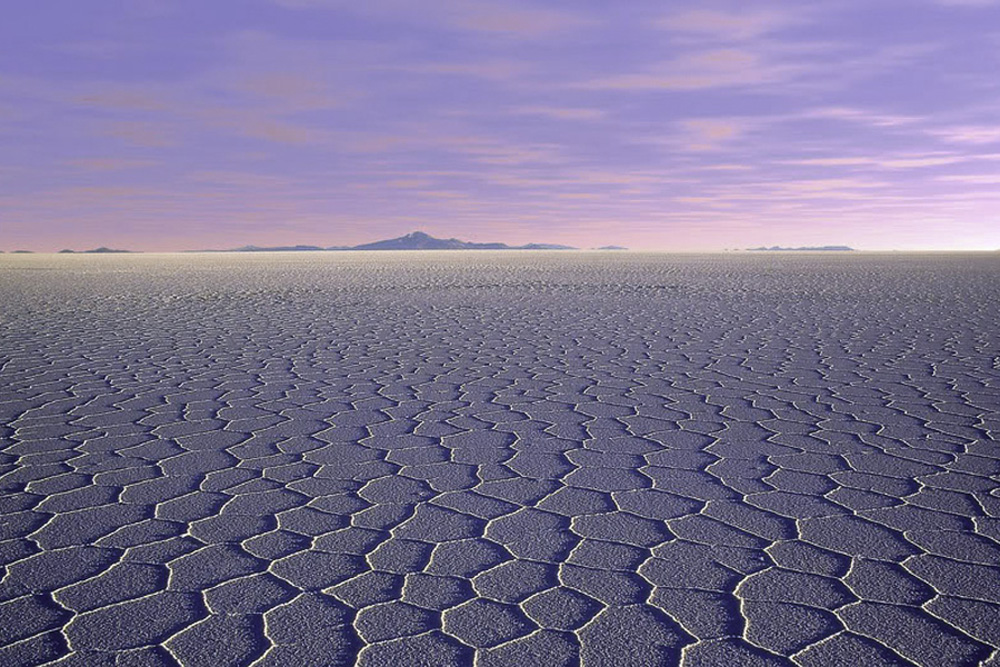
Uyuni is the largest salt flat in the world. Being one of the most famous places in South America and receiving more than 90,000 visitors a year, this region is as impressive as you can imagine! The salt flat has an extension of 10,582 kilometers and an altitude of 3,660 meters above sea level. But what makes this place so unique is the mirror effect that occurs after a rainfall, which blurs the boundaries between the sky and the earth, making it look like you are walking on clouds.
Bolivia
Bolivia has numerous salt flats and lagoons at where minerals can be obtained evaporite. The Uyuni salt flat has 10,000 square kilometers and is the world’s largest lithium reserve. The Coipasa salt flat has 3,300 square kilometers and an important richness in potassium salts. The total extension of salt flats and lagoons with evaporite resources in our country exceeds the 17 thousand square kilometers.
Bolivia Salt Flats
Bolivia has three salt flats in the Altiplano area that contain significant amounts of lithium reserves: the Salar de Uyuni, the Salar de Coipasa and the Salar Pastos Grandes.
Specialized studies indicate that, in the country, the extension of salt flats and lagoons with evaporite resources exceeds 17,000 square kilometers.
The Salar de Uyuni is the largest lithium reserve in the world with an estimated amount of 21 million tons that have been certified by the U.S. company SRK. It did its industrial capacity study on 64 percent of the plain, so it is clear that the famed salar has much greater potential.
In the mid 1970s, as part of an agreement between the French company Orstom and the Universidad Mayor de San Andrés (UMSA), studies and drilling determined that the Salar had reserves of 8.9 million tons of lithium.
The other salt flats considered suitable for lithium exploitation and industrialization are: Coipasa and Pastos Grandes. But these, unlike the first one, do not have a certification of their reserves.
Uyuni Bolivia Salt Flat
Uyuni, Bolivia It is considered the largest lithium reserve on the planet. It is located in the Daniel Campos province, in the department of Potosí, in the altiplanic region of the Andes Mountains.
With an extension of more than 10,500 square kilometers and an average depth of 10 to 12 meters, it is located 3,670 meters above sea level (masl) and is one of the largest in the world.
It has about 10,000 million tons of salt distributed in 11 layers that vary in thickness and can reach 10 meters on the surface. Its structure is formed by mud and superimposed layers of brine, and composed of minerals such as potassium, magnesium and lithium.
Initially, the Bolivian government focused all its efforts on the exploitation of this salt flat. However, it later decided to improve its production and also turned its attention to the Coipasa (Oruro) and Pastos Grandes (Potosí) deposits.
Uyuni Bolivia
There is a legend that the Salar de Uyuni was formed with the mother's milk spilled by the Tunupa volcano, when her newborn baby was stolen from her. Every year it is her tears that flood this sea of salt during the rainy season.
Imagine all the amazing photos you could take here. Whether you visit in the dry or rainy season, the Uyuni salt flat offers you an esplanade to experiment with your creative side. Be sure to bring your camera and photographic accessories, a must for taking pictures with an interesting perspective.
Bolivia
All this explains the exponential increase in lithium demand in recent years, which in 2020 was 330,000 metric tons and is expected to grow by 20 to 25% in the medium term, over the next 10 to 15 years.
Since then, the main use of the mineral has been in the manufacture of batteries, where, having replaced nickel, it forms part of around 95% of batteries of all types and in all kinds of devices, and has also been introduced with overwhelming success in the automotive market. That is why its demand has soared in recent years, making it a strategic mineral for the change of energy model that seeks to replace fossil fuels with renewable energies.
Why lithium is considered white gold
Lithium is the third element in the periodic table, after hydrogen and helium, and the first of the alkali metals. It was discovered in 1817 by the Swedish chemist Johan August Ar- fwedson, who demonstrated its presence in minerals such as spodumene and lepidotite.
An attractive silvery-white color, lithium is the least dense of all metals. In fact, it is so light that it floats on water, and so soft that it can be cut with a knife. However, the characteristic that currently makes it such a coveted and strategic element is its great capacity for energy storage, since, compared to other materials, it allows the accumulation of high charge densities in a relatively small space.
It is a highly reactive element, which is why it only exists in nature in the form of lithium minerals, which is why it did not begin to be synthesized on an industrial scale until 110 years later, during the Cold War, when it played an important role in the nuclear arms race. However, lithium’s big breakthrough came in the early 1990s, when the Japanese company Sony launched the first rechargeable lithium-ion battery on the market.
How Bolivia Can Change the Economy of Bolivia
Lithium is a very valuable mineral used to make batteries for cell phones, electric cars and computers. Bolivia has one of the largest reserves in the world, especially in the Salar de Uyuni. This resource can help the country a lot, generating income, creating jobs and improving services such as education and health. It can also help make Bolivia less dependent on gas and oil. However, using lithium also brings challenges. It is important to take care of the environment, protect the water and respect the communities living near the salt flats. In addition, Bolivia should seek not only to sell raw lithium, but also to manufacture products such as batteries to earn more and learn more. With good planning, modern technology and responsible decisions, lithium can be a great opportunity for Bolivia to grow sustainably and for many people to improve their quality of life.