
Santa Cruz de la Sierra-Bolivia
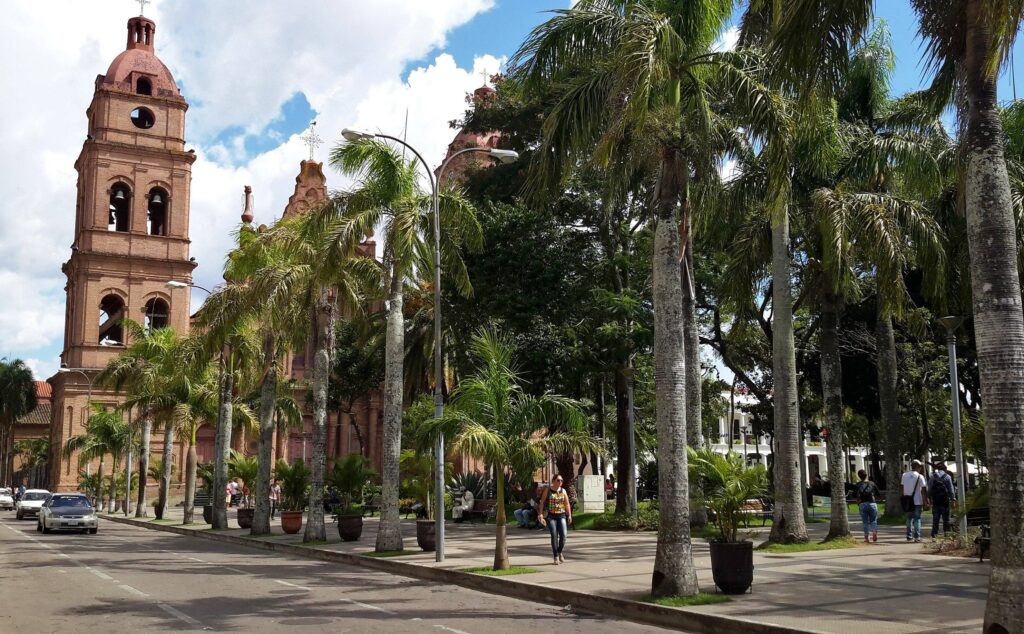
Santa Cruz de la Sierra Known as the city of the rings, Today, it is considered the economic center of Bolivia for the industry and farming activity.
History of Santa Cruz
Santa Cruz de la Sierra, founded on February 26, 1561, is the capital of the Santa Cruz department. Its foundation is considered an important event in Bolivia’s history.
The city was first established by the Spanish captain Ñuflo de Chaves, who led an expedition from Asunción, Paraguay. He named the new town after his hometown in Extremadura, Spain. The place was chosen carefully it was near the Sutó stream, in a strategic area meant to help expand Spanish control in the Gran Chaco and to improve trade with local Indigenous communities.
Before the Spanish arrived, the area was home to several Indigenous groups, including the Chané and Guaraní peoples. The arrival of Ñuflo de Chaves marked the beginning of colonization, which deeply changed the region’s social and political life.
Although the city faced many early challenges such as attacks and harsh conditions it began to grow. Its history includes two major relocations: first to Cotoca in 1590, and later to its current location in 1621. From there, it became a key urban and economic center.
Ñuflo de Chaves deserves to be mentioned in the annals of history, not so much because he was the founder of Santa Cruz de la Sierra, but as a conqueror and strategist. Constructing a new city in a far and forbidding land evidences his ambition and courage to undergo difficulties.
Although he was commissioned to pillage other lands, he planted Santa Cruz as a gesture of disobedience and resolve. This was a clear demonstration of his resolute will and foresight for the future.
His memory persists to this day in the culture of Santa Cruz and in the identity of Bolivia. Every year in the anniversary festivities for the city, he is not forgotten as a key figure in the history of the region.
San Xavier
Heritage
Santa Cruz heritage is not only rooted in material things, but also traditions, music, dances and food, which are part of the cultural legacy of the region.
To safeguard this rich heritage, Santa Cruz’s cultural, historical and natural riches are being protected, developed and promoted. El Deber said the declaration of the Cathedral of Santa Cruz as Departmental Cultural Heritage is part of this work.
Preserving the culture in Santa Cruz, is the basis for the legacy of historical and cultural memory of the department, as well as for tourism and sustainable use.
Traditions
Santa Cruz de la Sierra is a very happy and festive part of Bolivia. Its traditions are a blend of Indigenous roots, Spanish heritage and a warm spirit manifested by its people.
Among its many festivities, one of the most significant is the Carnaval Cruceño. It’s famous for the joy, the colorful outfits, the dancing formations, the music and the parades. Unlike the Andean carnival, at Santa Cruz you will frequently see floats and Brazilian-style drum groups but with a Santa Cruz twist.
Another unique culture is the Fiesta of the Virgin of Cotoca, the guardian saint of eastern Bolivia. Thousands of pilgrims walk on foot from the city to the town of Cotoca each year in an act of faith and devotion.
The Anniversary of Santa Cruz is also a time of great public pride, on September 24. That day is marked by civic ceremonies, school parades and folk dances. This is a moment for the city to honor its history and identity.
Carnaval
Keperi, Bolivia dishes
The food from Santa Cruz is a blend of Indigenous and Spanish traditions. It’s a tasty, homemade cake you can share with the family.
For its part, Santa Cruz de la Sierra has a very rich and varied market of food, encouraging the consumption of local products like carne, churrasco (cow meat to grill) and chicha (local drink).
One of the widely consumed dish is majadito, cooked in a similar fashion as puchero but containing charque (dried meat) and is seasoned with paprika. Another typical dish is locro, a soup prepared with rice, charque (dried and salted meat of the Andes) and colorau (natural coloring). Famous plato cruceño consists of fried plantains, rice and fried eggs, served with a small cold salad.
There’s also peanut soup, creamy and full of flavor, which people love. A well-liked snack is sonso, a casava and cheese based snack grilled or baked. Other typical foods include patasca, a thick and unusual soup made from corn and meat, and pastel de gallina, a kind of chicken pie.
Culture
Most Santa Cruz legends and tales are Spanish and European in origin, mixed with Guaraní and Arawak traditions. A fine exponent of this cultural interflow is the poet Antonio Anzoátegui Suárez (Camba Florencio), who embodies the resiliency, wit, and humor of the Cruceño in his poems and narratives.
Santa Cruz is primarily influenced by Spanish and European cultures, in addition to those of the Indigenous peoples such as the Guaraní, Chiquitano, Arawak, and others. This fusion has resulted in a distinctive culture felt in the music, dances, language and daily life of the area. The mixture of both of these roots makes Santa Cruz a special case in Bolivia.